Don't private schools only cater to the rich and elite?
Private schools are not just for the wealthy. In 2019, nearly 50% of students were enrolled in 4.5 lakh private schools. Of these students, 45% pay less than INR 500 as monthly school fees and only 10% pay more than INR 2,000 per month. Such affordable schools, called budget or low-fee schools, dot every state in the country. The majority of private unaided schools are budget schools that cater to individuals from low-income populations. The data contradict the common perception that private education is a luxury good.
Proportion of enrollment in private schools at various fee tiers
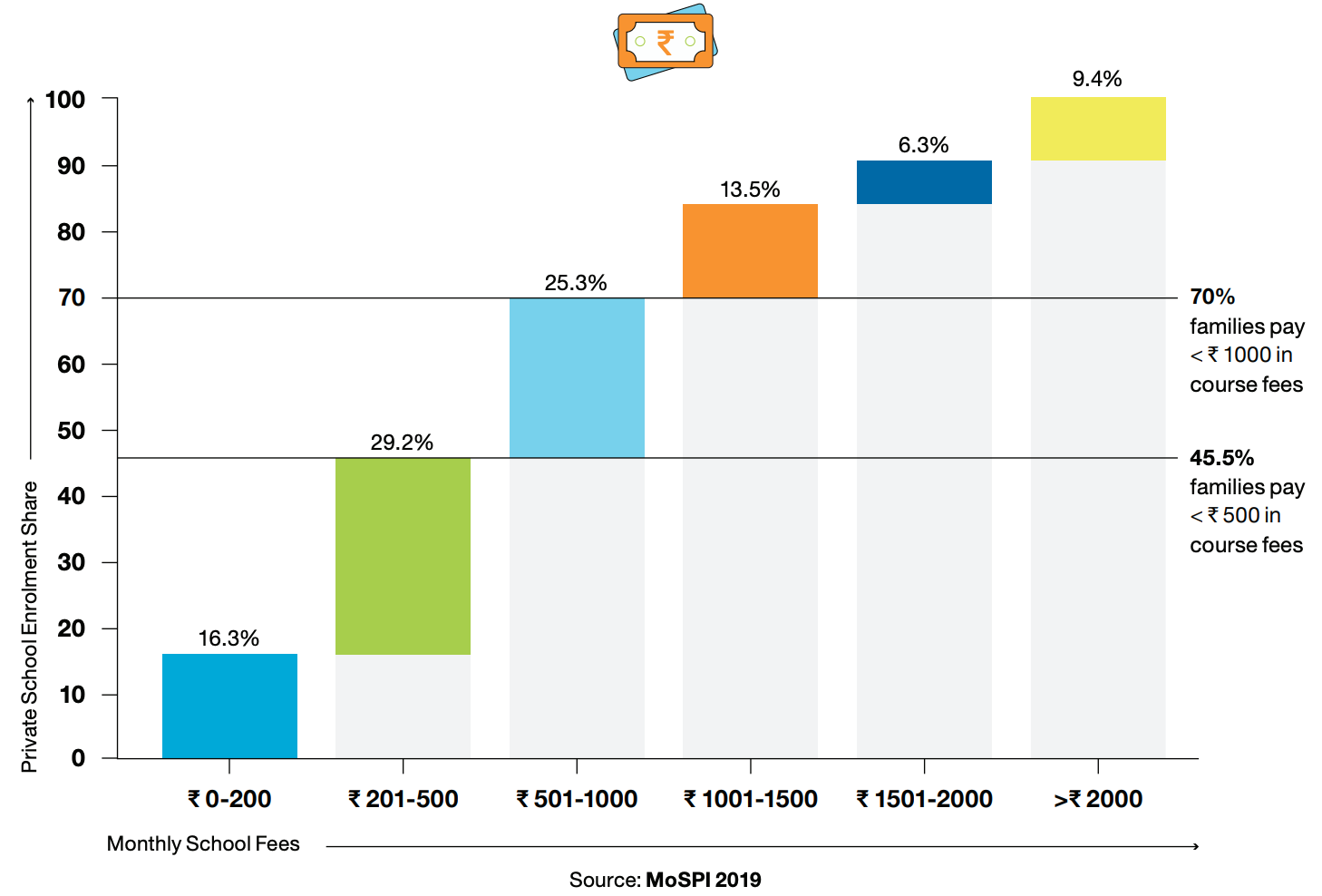
Source: Central Square Foundation. 2020. State of the Sector Report on Private Schools in India.
Even historically, government schools were not the norm for the poor and vulnerable in India. In the early 1800s, traditional institutions like pathshalas, madrassahs, and gurukulas imparted education. These institutions were kept alive by revenue contributions from the community, including illiterate peasants. British officials across Bengal, Bihar, and Bombay noted the widespread prevalence of village schools in India, with some stating that there is hardly a village, great or small, throughout our territories, in which there is not at least one school, and in larger villages more. Communities have long organised and funded education for their children without relying on government provision.
Education was not an exclusive privilege enjoyed only by upper-caste members. Per records from 1822-25, in an Oriya-speaking region, only 35.6% of students belonged to the three upper varnas (Brahmins, Kshatriyas, and Vaishyas), and 63.5% were Shudras and other castes. Researchers observed similar trends in the indigenous schools of Tamil- and Malayalam-speaking regions. This evidence challenges the assumption that private provision inherently excludes marginalised communities.
When considering how we can support low-income communities in accessing affordable schooling, it is crucial to recognise the role private schools have played and continue to play in achieving this goal.
Comments
Discussion is moderated. Sign in with GitHub to leave a comment — comments are reviewed by the Centre for Civil Society team before publishing. To request removal of a comment, email contact@ccs.in.
Sign in with your GitHub account to leave a comment. Comments are reviewed by the Centre for Civil Society team before they appear publicly.